pronounced tie-see
Menu

Menu
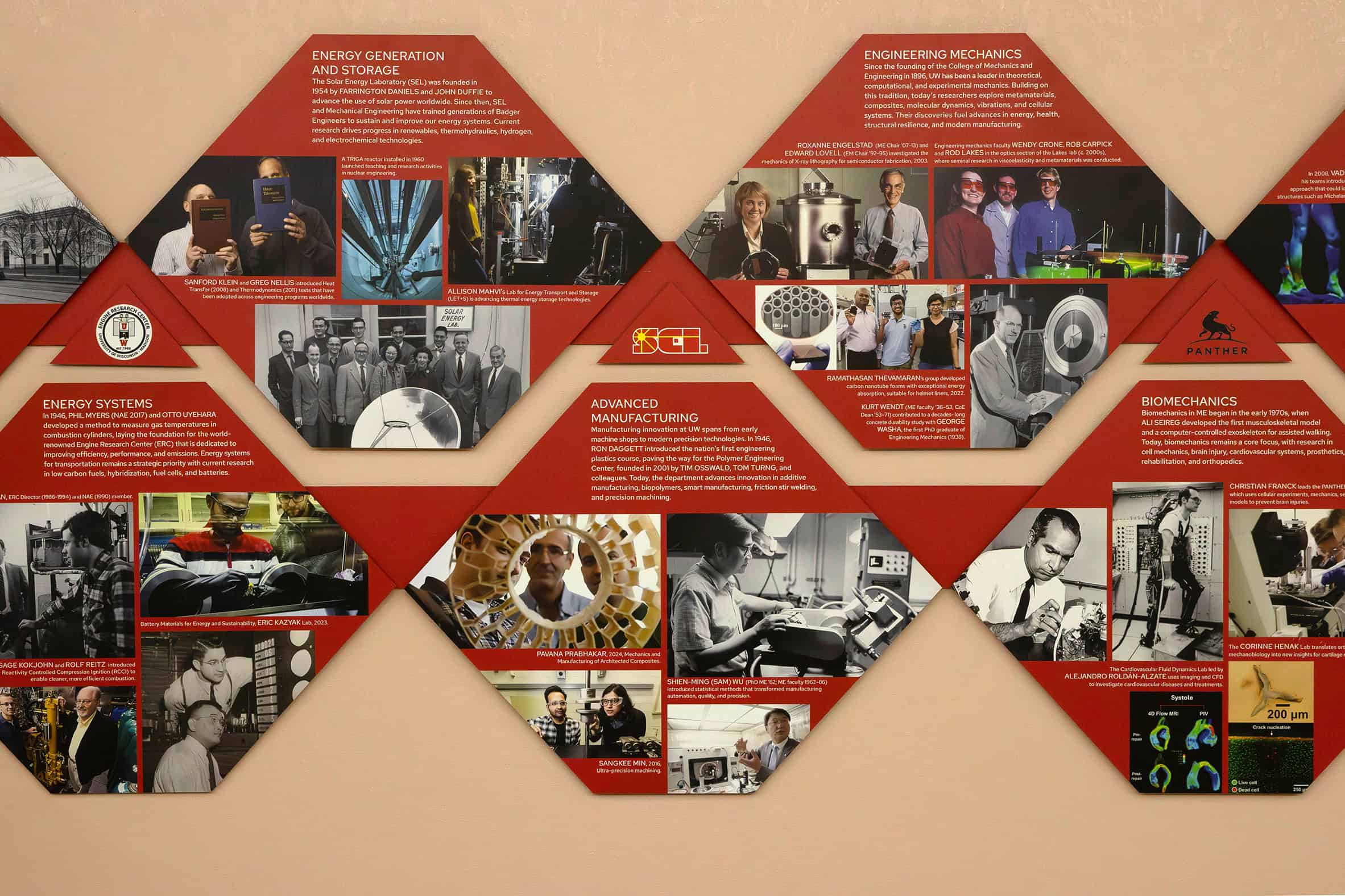
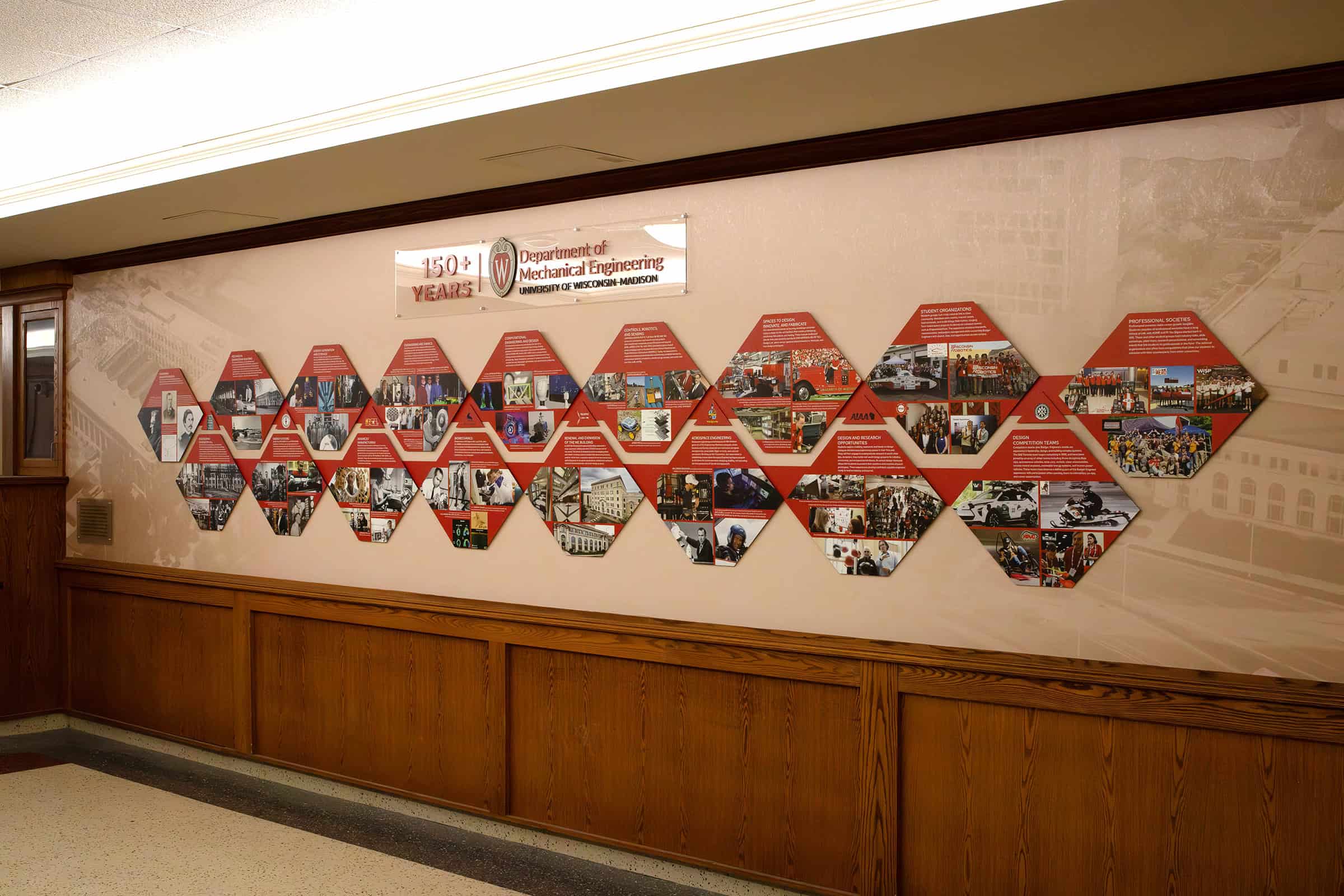
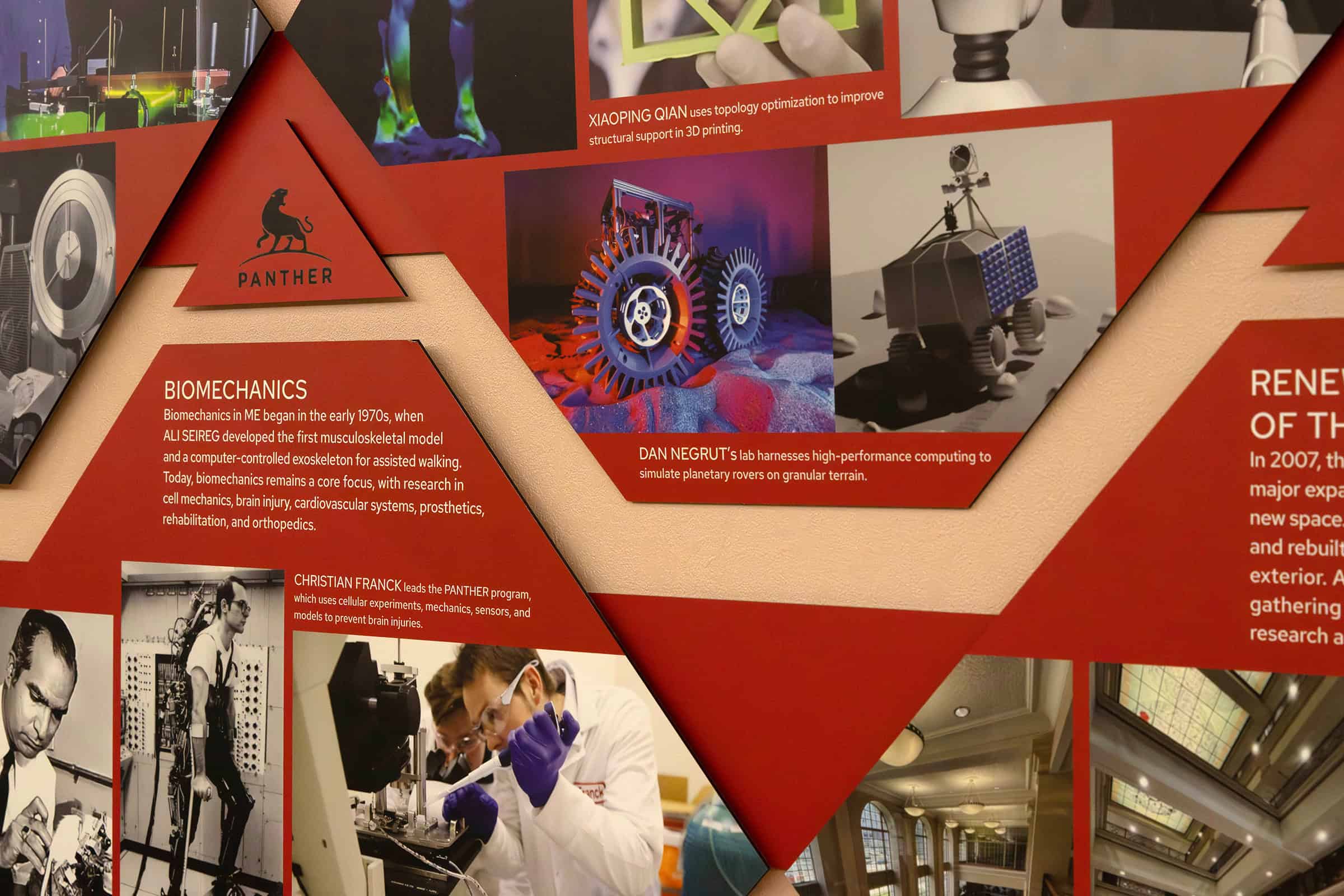
From the beginning, the Mechanical Engineering team brought an enormous amount of material to the project.
Historical photography. Department milestones. Student organizations. Research highlights. Competition teams. Industry partnerships. Academic achievements. Alumni accomplishments.

“There was a lot of content to work with. We probably went through five different versions because they had so much information and so many photos they wanted included.”
- Kristyn Hodel, Experiential Designer at Thysse
Early concepts explored more traditional layouts using circles and rectangles, but the project team quickly realized the wall needed something more visually dynamic—something capable of organizing large amounts of information without feeling rigid or overwhelming.
The department gravitated toward a hexagonal system.
The shape felt appropriate both visually and symbolically. Hexagons subtly reference forms commonly associated with mechanical engineering—nuts, bolts, tools, and precision-machined components—while also allowing the content to feel modular and interconnected rather than locked into a strict chronological timeline.
That flexibility became important quickly.
Originally, the installation was envisioned as a more traditional linear history wall with a stronger emphasis on dates and timelines. But as the project evolved, the department realized they wanted the space to feel more exploratory and representative of the program as a whole rather than functioning strictly as a chronological archive.
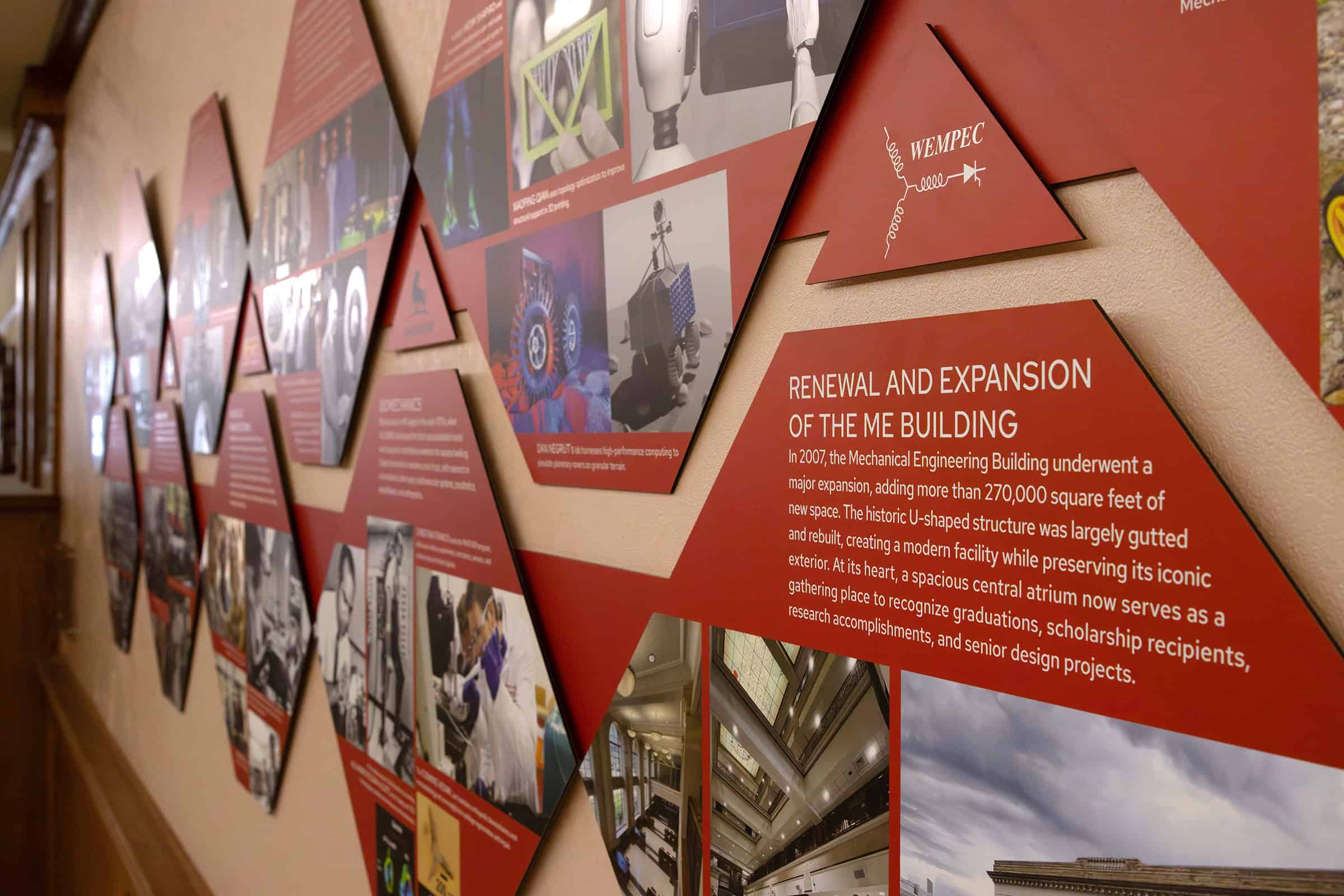
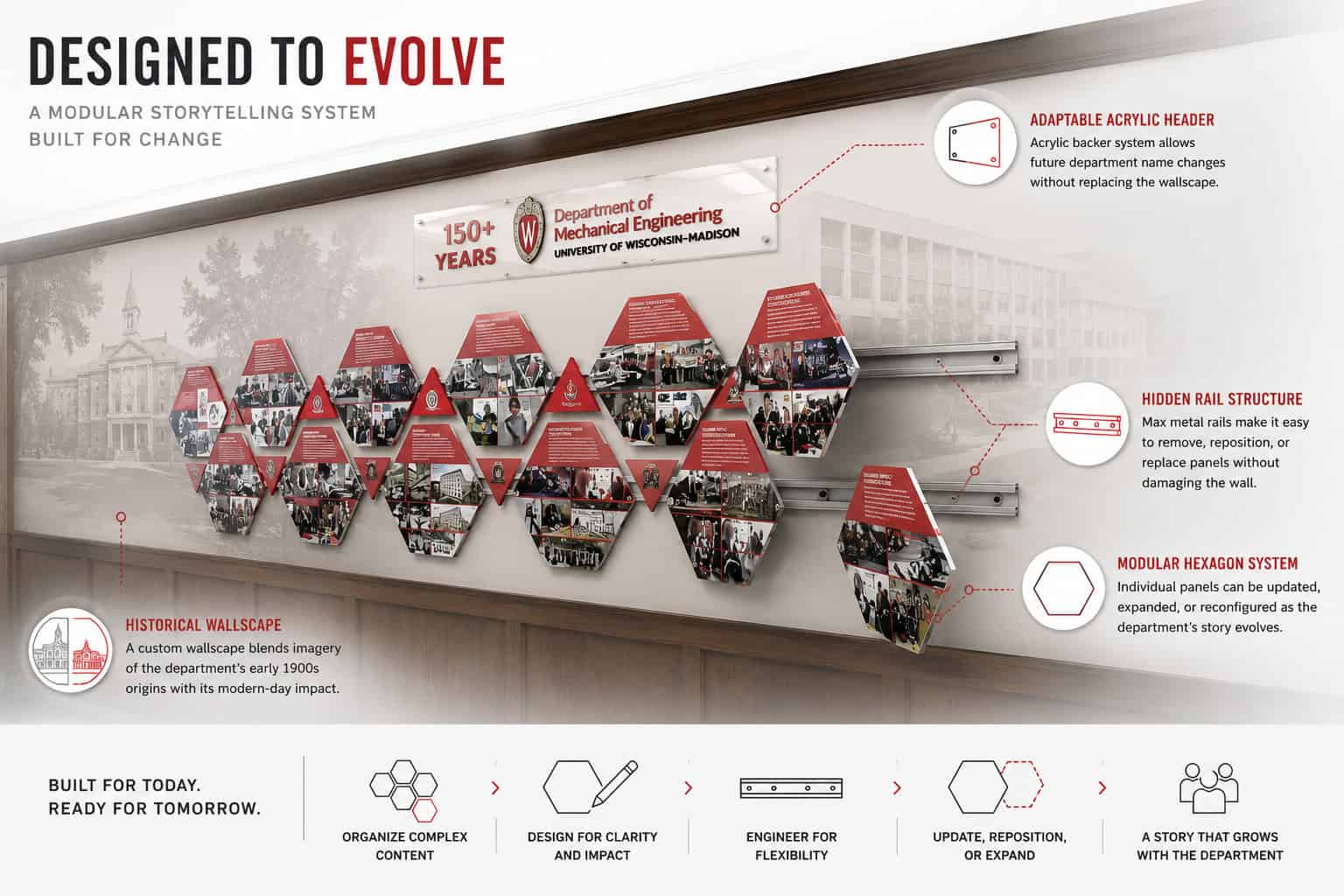
The final design uses seventeen large hexagonal panels, supported by smaller triangular inserts highlighting student clubs, organizations, and logos throughout the installation.
One of the most thoughtful aspects of the project is something many visitors will never consciously notice: the wall was intentionally designed to change.
Increasingly, universities and organizations are looking for environmental graphics systems that can evolve over time without requiring complete reconstruction every few years. The Mechanical Engineering team anticipated future updates, potential departmental changes, and evolving content needs long before the wall was installed.
That thinking shaped nearly every design and fabrication decision in the project.
Rather than mounting the hexagonal panels directly to the wall permanently, the panels were installed using max metal support bars hidden behind the graphics system. The approach allows individual elements to be removed, repositioned, updated, or expanded later without damaging the wallscape itself.
Even the department title signage was designed with future changes in mind.
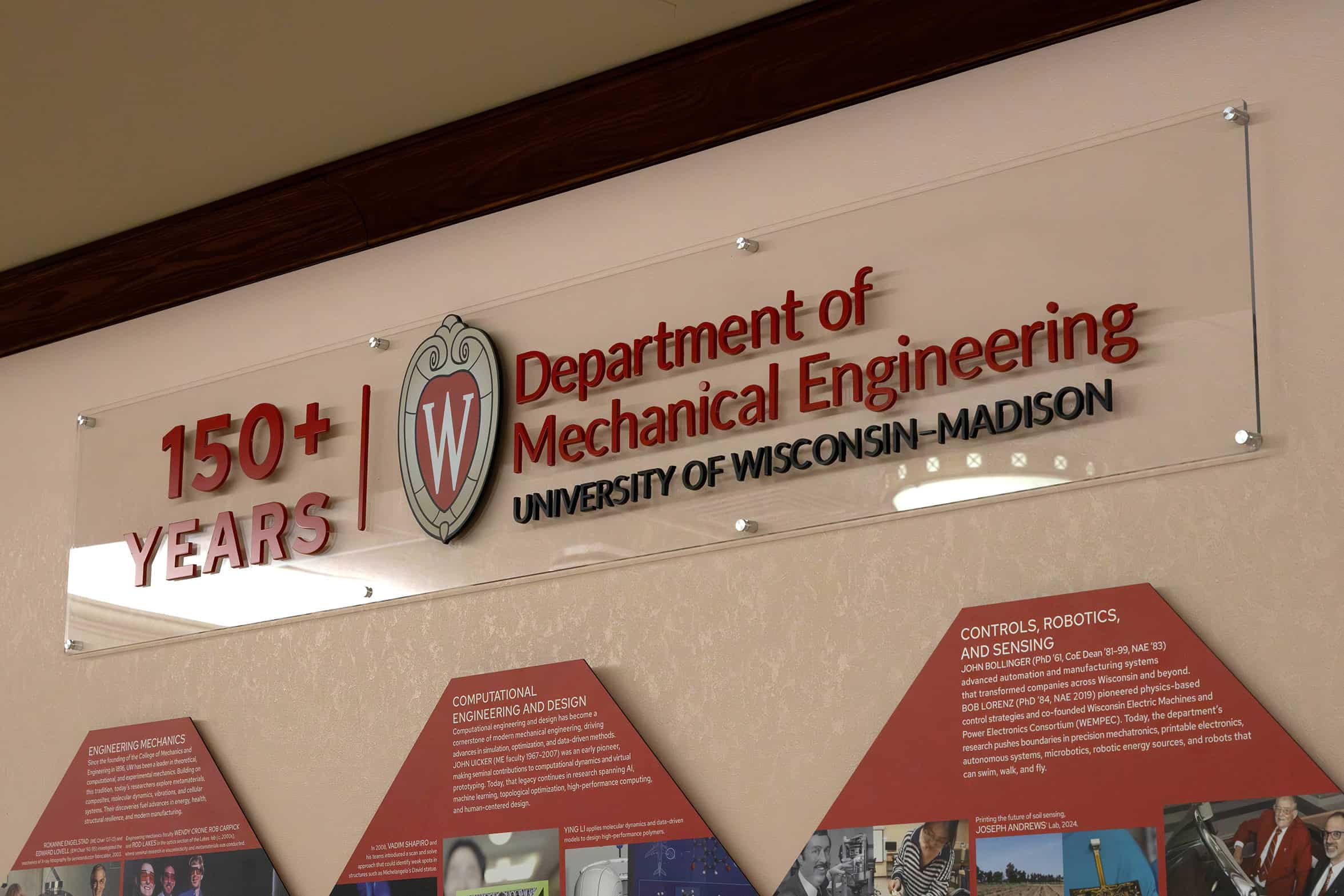
Instead of mounting the acrylic title lettering directly to the wall, Thysse mounted the signage to a removable acrylic backer system after learning the department anticipated a possible name change in the coming years. That decision allows the title area to be updated independently without requiring the entire wall graphic to be rebuilt.
It’s a subtle detail, but one that reflects a larger shift happening throughout experiential graphic design: creating environments that support long-term adaptability instead of static permanence.
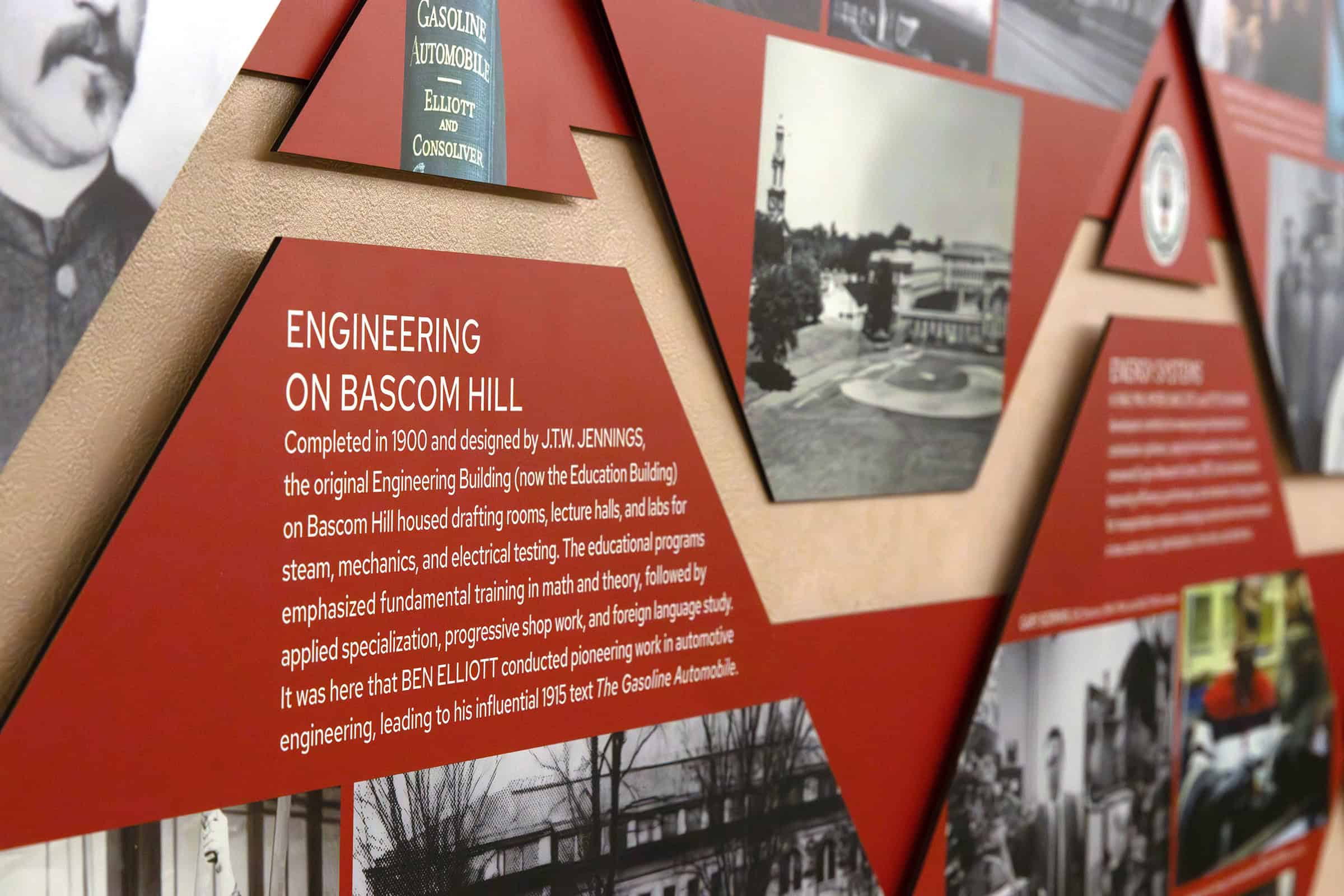
As the project moved toward final production, the original design direction began exceeding the department’s budget expectations.
That moment could have forced compromise.
Instead, it improved the project.
The team pivoted to max metal panels as a more cost-effective solution for the hexagonal graphics system. But in retrospect, the material choice ended up feeling even more appropriate for the environment.
Kristyn noted, “The max metal is more fitting for the Mechanical Engineering building—there’s alignment there that makes the overall experience even stronger.”
The slightly more industrial feel of the material complemented both the engineering identity of the department and the modular structure of the installation itself. What began as a value-engineering exercise ultimately strengthened the authenticity of the final environment.
That same mindset carried into the surrounding wallscape graphics.
Behind the installation, a large-scale mural blends imagery of the department’s original early-1900s building with photography of the current facility, visually connecting the program’s history with its present-day identity.
The layered approach helps the entire installation feel less like a standalone display and more like an integrated part of the architectural space.
Although the final installation occupies a single corridor wall, the project itself stretched close to a full year from concept development through completion.
Part of that timeline came from the sheer amount of content involved. Part came from the extensive iteration process required to organize that content meaningfully. And part came from the department’s evolving vision for the broader space itself.
At one point, the project scope included a much larger environmental redesign extending across the entryway and adjacent walls, replacing older display cases and introducing additional informational graphics about the department’s programs and offerings. While those future phases have not yet moved forward, the current installation was intentionally designed to support future expansion opportunities if the department decides to continue developing the space.
For Thysse, the project also marked the company’s first collaboration with UW Mechanical Engineering—one the team hopes will continue evolving over time.
The finished installation succeeds not simply because it tells the department’s story, but because it was designed with the understanding that the story itself will continue changing.
New student organizations will emerge. New achievements will happen. Research priorities will shift. Department identities will evolve.
Rather than treating the wall as a static historical artifact, the system was designed to accommodate that reality from the beginning.
In many ways, that approach mirrors engineering itself: thoughtful systems design built around adaptability, structure, and long-term functionality.
And for a department dedicated to solving complex problems through intelligent design, that feels like a fitting outcome.