pronounced tie-see
Menu

Menu


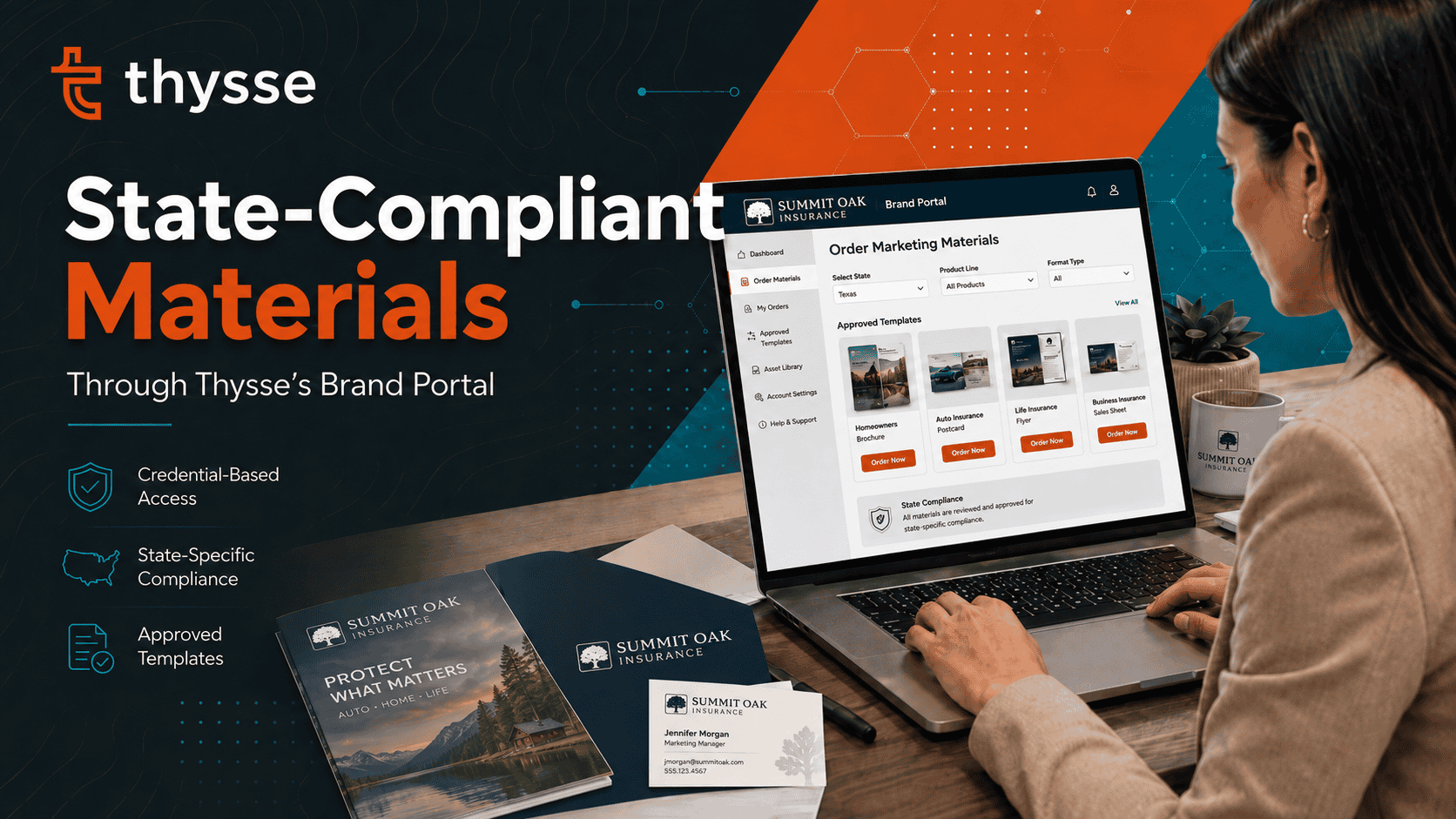
Thysse runs a compliance-grade Brand Portal for a national insurance provider whose roughly 2,000 independent agents and marketing partners operate across all fifty states. The portal ties every user’s access to their credentials and state licensing, keeps 1,500+ print assets as a single version-controlled source of truth, and assembles kits on demand so a regulatory change never turns finished kitted inventory into scrap or rework. Centralized reproduction in Thysse’s G7 Color Master Certified facility holds brand and color consistent, while an automated daily sync provisions and revokes access without manual work. In production for over eight years, the system lets a dispersed, highly regulated sales force operate as if it were centralized.
A distributed field force is hard to control precisely because it’s distributed. Agents aren’t employees; marketing partners and funeral homes operate independently. Each needs fast, self-service access to forms, kits, and marketing materials — but in a regulated industry, “fast and self-service” can’t mean “anything goes.” Access has to be tied to licensing and geography. Materials have to stay current as state rules change. And pre-printing in bulk to save money creates its own exposure: a single regulatory change can turn a warehouse of forms into scrap.
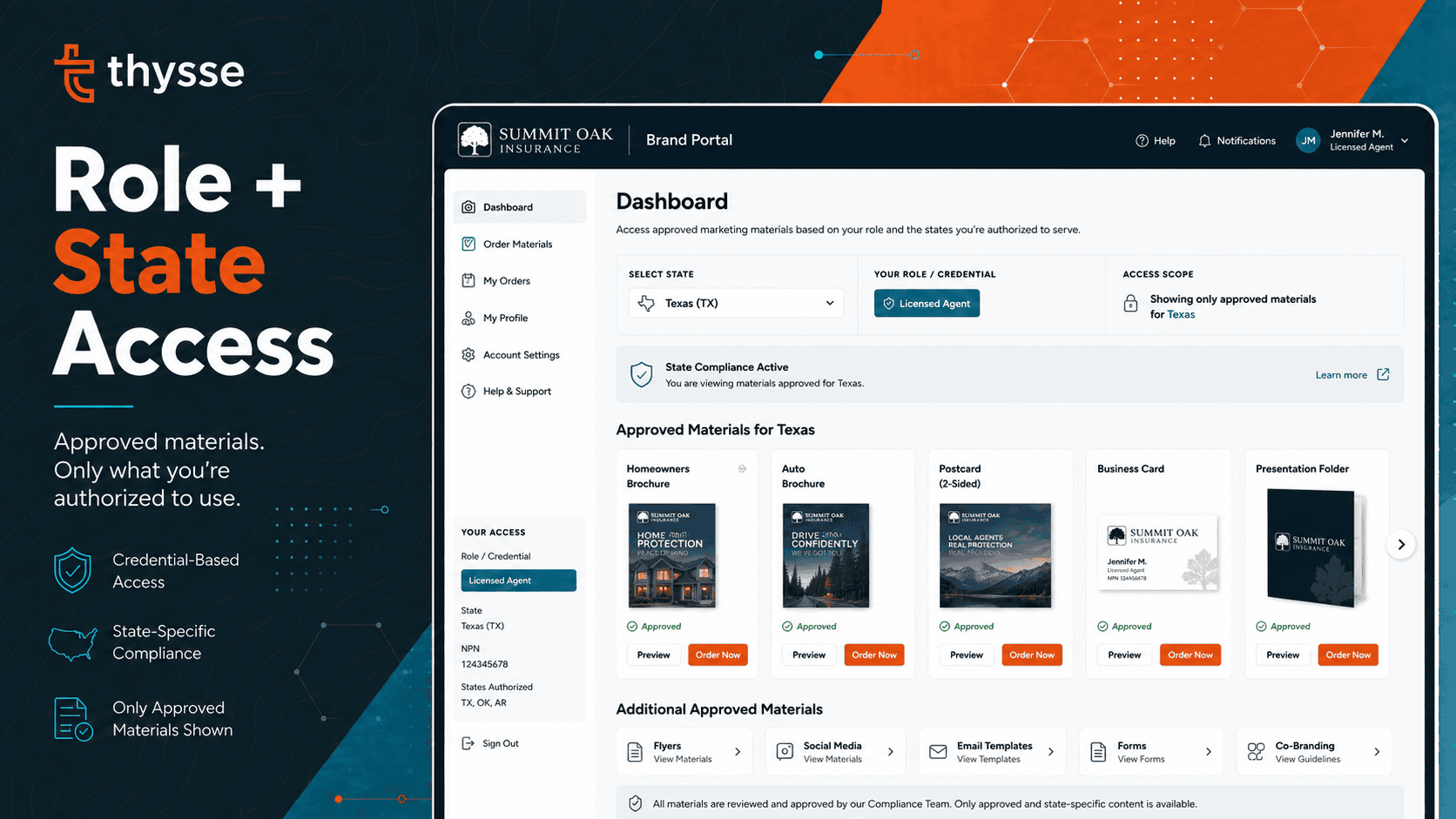
Thysse built and operates a web-based Brand Portal that behaves less like a print catalog and more like a controlled distribution platform. Every user signs in through single sign-on and sees only what they’re authorized to see — the product lines, categories, and forms appropriate to their role and their state. Behind that simple experience runs a deep, centralized permission model and an automated, daily connection to the client’s own systems.
User accounts aren’t created or maintained by hand. Each day, the client’s internal systems hand off a user file that the Brand Portal ingests automatically — creating new accounts, updating permissions, and revoking access without anyone at Thysse touching it. Access is tethered to each user’s credentials and state licensing, so an agent simply doesn’t see assets, products, or forms they aren’t authorized to sell where they sell.
Over 1,500 print assets live in one ecosystem, which makes the Brand Portal the authoritative version of record. When regulations change, so does the form. Agents are trained not to save local copies or reproduce them; instead, they return to the source their compliance team keeps current. That quietly removes one of the most common compliance failure points in any distributed organization.
Another key benefit and byproduct of the system is brand control. With centralized reproduction of all color print assets within Thysse’s G7 Color Master Certified facility, the client’s color and quality consistency is exact. Centralized control over the digital files means brand owners have direct control over the assets.
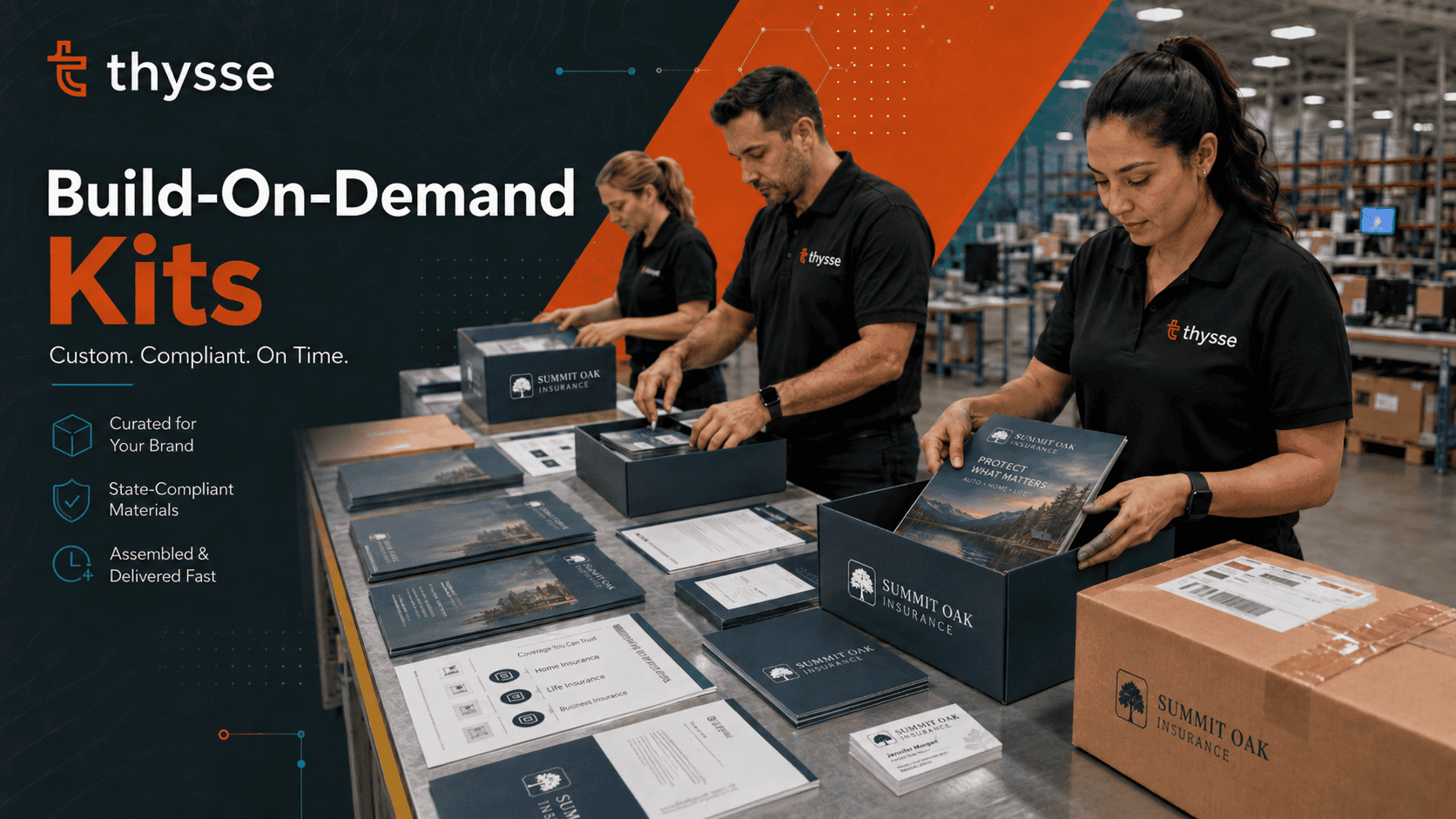
A wide range of kitted literature and pocket folders are used by this customer, and this is where the model creates additional savings. Rather than assembling and warehousing finished kits, Thysse produces the component forms in sensible quantities, inventories them, and assembles each kit only when it’s ordered. Back-end rules enforce which forms are required and the exact order they’re collated in, so the people packing them don’t have to be compliance experts. Agents can build kits on the fly — opting components in or out, selecting the right state-specific pieces — and the system guarantees the result is complete and correctly ordered. When a regulation changes, there’s no shelf of obsolete finished kits to scrap; only the affected form updates.
That difference isn’t theoretical. Several other Thysse customers on the platform came aboard specifying that dozens of literature kits were to be fully pre-assembled. But as compliance changes repeatedly forced rework and obsolescence, the frequently-changing kits were migrated to build-on-demand — trading the illusory savings of pre-assembly for protection against obsolescence, and real cost savings.
Because requirements differ in every jurisdiction, a single change can impact every tethered kit in all relevant states. With over 1,500 print assets and virtually infinite kitting options, the platform elegantly minimizes the cost and scope of the compliance problem. Fast distribution and standardized cost remove the need for agents to stock large quantities of assets on site. It’s more time-, cost-, and storage-efficient to keep small quantities of print assets on hand and replenish them frequently to ensure compliance.
Obsolescence is a real cost — especially when internal, state, and federal policies can create it. This particular client also underwent a rebrand, and their minimal print-inventory position was ideal. Competitors could easily have found themselves trashing seven figures of obsolete print inventory at their operational scale. The Brand Portal also made updating branding through to implemented print assets as fast and efficient as possible — “slick,” even.
Independent agents can personalize materials — adding their photo and contact information to a brochure, for instance — and order exactly what they need, down to a single folder packet, thanks to digital production economics. Meanwhile, the client’s own Forms Expert defines every rule centrally: what’s required, what’s optional, and what each user can access. The field gets flexibility; the brand and compliance teams maintain control.

The result is a field force that can move quickly without moving out of bounds. Agents get what they need in a few clicks. The compliance team can trust that what’s being used is current, compliant, and authorized. And the client avoids the quiet, expensive waste of obsolete inventory. In use for over eight years, this client’s Brand Portal now serves roughly 2,000 users across all fifty states and manages 1,500+ forms and assets — embedded deeply enough that the client’s own team manages the content directly.
It’s tempting to call this a printing program, but it’s much more than that. It’s the infrastructure that lets a large, dispersed, highly regulated sales organization operate as if it were centralized — without slowing anyone down. The printing is the easy part. The custom asset and logistics management system is what makes it a competitive advantage.
Every asset lives in one version-controlled Brand Portal that serves as the authoritative source of record. Agents are directed to pull current materials from the portal rather than save or reproduce local copies, so when a form changes the old one stops circulating.
Access is tethered to each user’s credentials and state licensing. A daily automated sync from the client’s systems provisions and updates accounts, so agents see only the products and forms they’re authorized to sell in the states where they operate.
Because kits are built on demand and inventory is kept minimal, a regulatory change updates only the affected form — there’s no shelf of pre-assembled, now-obsolete kits to scrap.
All color print assets are reproduced centrally in Thysse’s G7 Color Master Certified facility, and brand owners control the digital files directly — so color and brand stay consistent across every asset and every state.
Yes. Agents can personalize items such as brochures with their photo and contact information and order down to a single packet, while the client’s Forms Expert defines centrally what is required, optional, and accessible to each user.
Centralized digital control makes updating assets fast, and a minimal-inventory position means there’s little obsolete stock to discard — so a rebrand reaches printed materials quickly and without large-scale waste.
See how a Brand Portal could centralize and de-risk print for your distributed organization. Explore the Brand Portal and commercial print capabilities, or browse related work.