pronounced tie-see
Menu

Menu
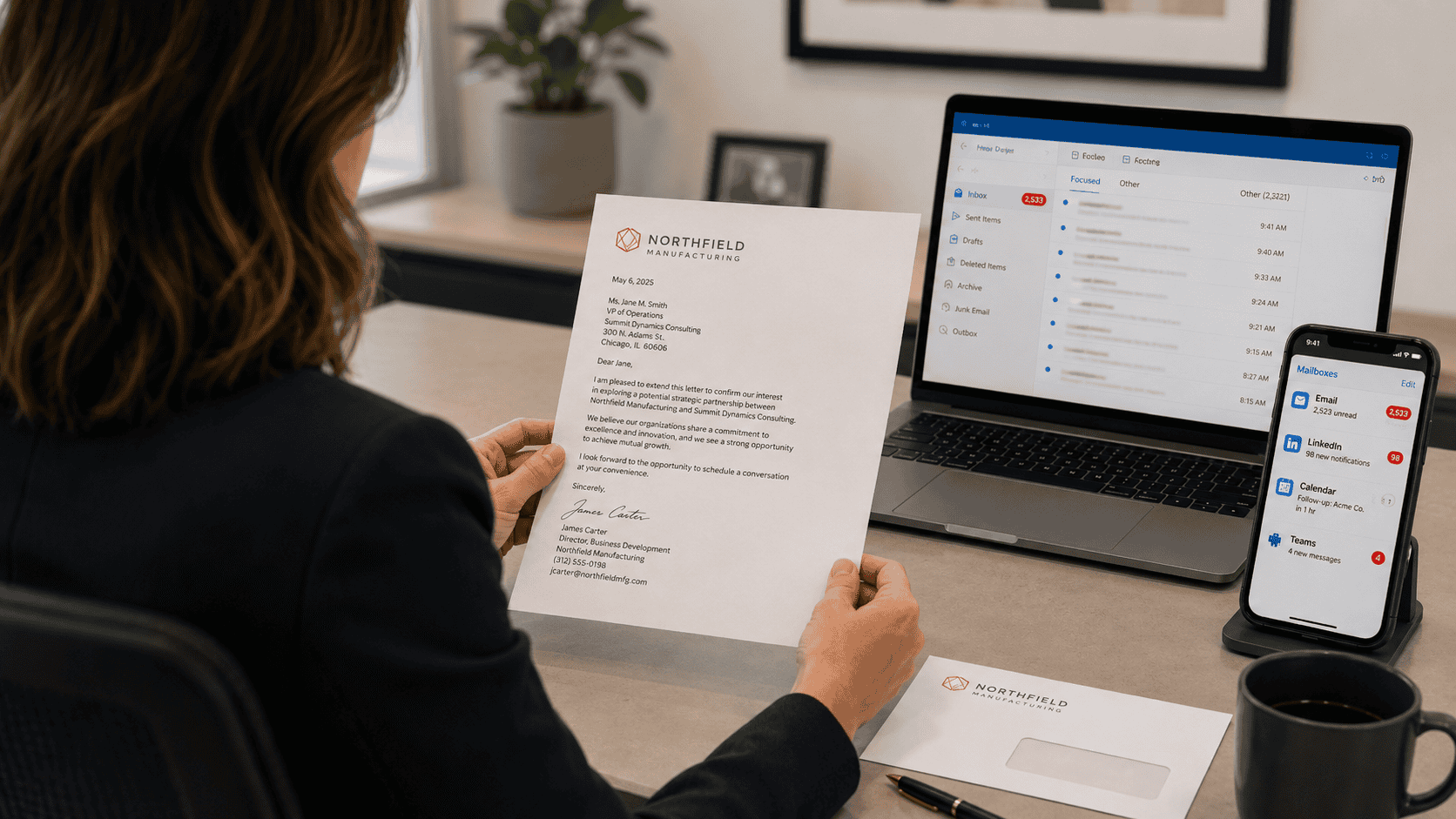
A mid-sized organization was using marketing signals to identify promising contacts, but digital outreach was struggling to break through. Thysse helped add personalized direct mail and connected USPS delivery activity back to the organization’s CRM, where existing automation coordinated email and Sales follow-up.
Compared with a larger historical email-only campaign, the print-led sequence saw 26% higher open rates, 92% higher click rates, 53% higher click-through rates and 148% higher reply rates.
The organization already had marketing signals helping its team identify promising contacts. Reaching them was getting harder.
Those contacts were also seeing digital ads, receiving emails and hearing from other marketers competing for the same attention. The organization wanted to test whether direct mail could help its outreach stand apart while keeping the automation and visibility its team relied on.
Thysse helped bring a tangible touchpoint into the existing campaign without separating print from the digital workflow around it.
Every two weeks, the organization identified qualified contacts based on recent marketing signals and its own campaign criteria.
Its marketing team supplied Thysse with the mailing list, representative-specific letter content and assets and the CRM record IDs needed to connect later activity back to the correct contacts.
The mailpiece itself was intentionally simple: a personal letter written in the voice of a subject-matter expert and sent from the appropriate representative.
Variable data applied the correct signature and contact information, giving the piece the feel of one-to-one outreach at campaign scale.
Thysse processed the lists through CASS/NCOA, identified available postage savings, handled variable data printing and mailing.
At the same time, Thysse developers worked with the client’s team to connect USPS delivery signals directly to its CRM.
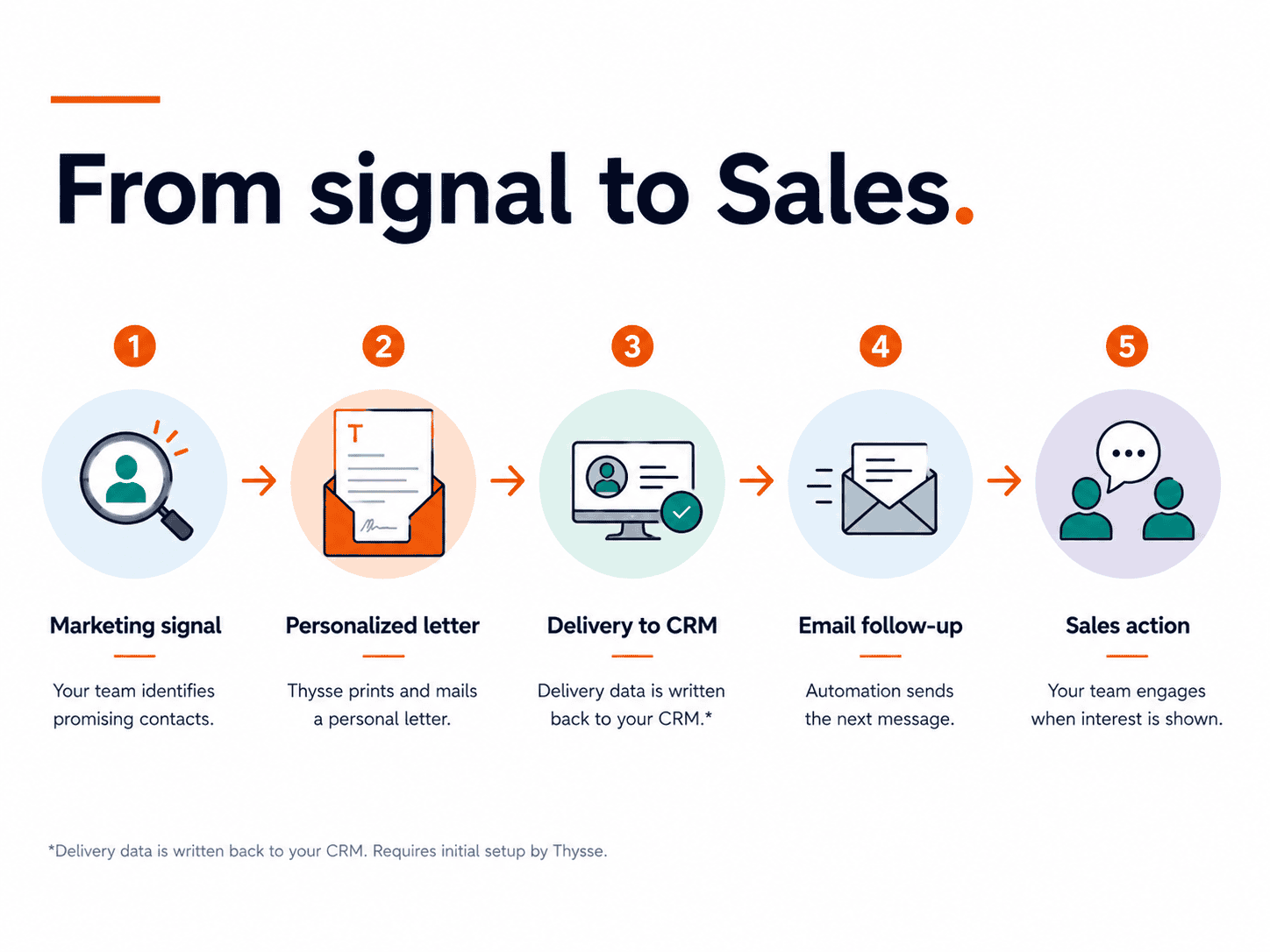
The workflow followed six steps:
That process allowed direct mail activity to become part of the same customer record already being used by Marketing and Sales.
The emails were designed to feel like a continuation of the letter rather than a separate campaign.
The first message referenced the mailing directly, giving the recipient a familiar name and recent interaction to connect with the email.
Later messages still acknowledged the letter, but the emphasis gradually shifted toward relevant expertise, possible needs and reasons to continue the conversation.
That gave the campaign a tangible reference point in an otherwise digital journey. The letter earned a moment of attention, and the follow-up gave that moment somewhere to go.
For marketers dealing with crowded inboxes, email fatigue and digital ad saturation, the approach offers another way to reach an audience while keeping digital follow-up efficient.
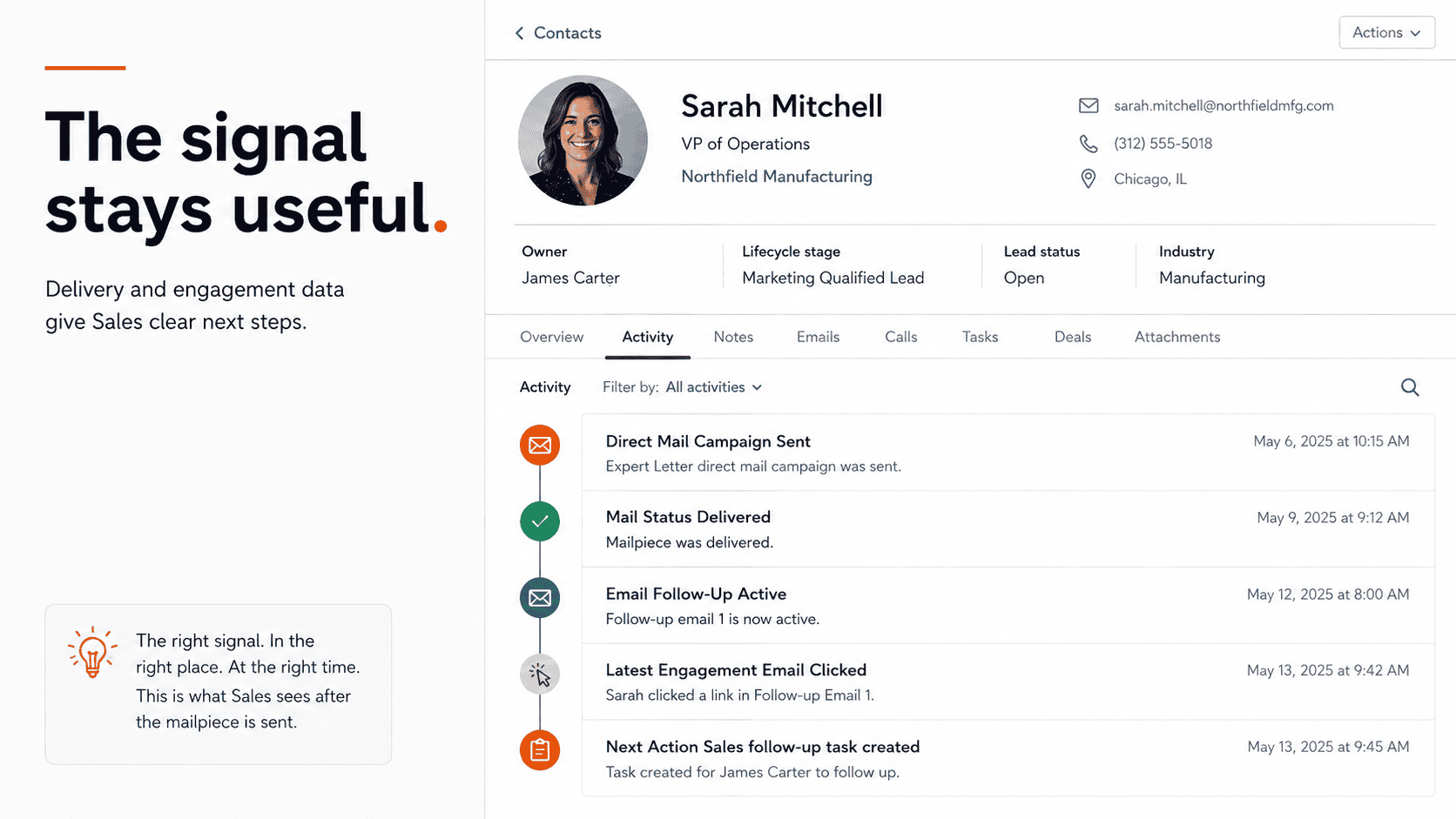
Delivery information was written back to the corresponding CRM record, including the letter campaign and delivery date.
That gave Marketing and Sales visibility into what a contact had received before the next digital interaction occurred.
As emails went out and recipients engaged, those activities continued building on the same record. A click or reply could eventually create an automated task for the appropriate Sales representative.
The result was a clearer view of the journey from physical outreach through digital engagement and Sales follow-up.
Early in the campaign, matching USPS delivery data back to CRM records required about five hours of manual work each week.
Adding persistent user IDs and daily uploads reduced that to about one hour. As the workflow matured, the process became nearly hands-off, with only periodic QC checks needed.
The Spring 2026 print-led campaign saw stronger engagement than a larger historical email-only campaign in the same campaign family.
| Metric | Relative difference for the print-led campaign |
| Open rate | 26% higher |
| Click rate | 92% higher |
| Click-through rate | 53% higher |
| Reply rate | 148% higher |
Manual processing time: Reduced from about 5 hours per week to periodic QC checks
The print-led sequence delivered 10,230 emails across three follow-up messages. The historical email-only campaign delivered 23,115 emails across three messages.
Reply activity was particularly notable. The print-led campaign generated 68 replies, compared with 62 replies from more than twice as many delivered emails in the digital-only campaign.
The campaigns ran at different times and varied in audience composition and messaging, so the comparison is directional. Across the available benchmarks, however, the print-led sequence produced stronger engagement on every metric shown above.
Marketing signals can tell a team who may be worth reaching. The channel used to act on that information still matters.
Here, personalized direct mail gave the organization a tangible way to reach contacts experiencing a steady stream of digital communications. USPS delivery data then brought that physical interaction back into the CRM, where existing automation could continue the campaign.
The result was a practical combination of tangible outreach, centralized campaign data and automated follow-up — with stronger engagement than the organization’s larger historical email-only benchmark.
Break through the digital static. Keep the signal connected.
Thysse can work with your team to connect USPS delivery data to matching CRM records through custom development. That allows mail activity to become part of the same workflows and contact history already used by Marketing and Sales.
Your team identifies the audience and supplies the mailing list, variable data and CRM record IDs. Thysse can handle CASS/NCOA processing, postage optimization, Variable Data Printing, production, mailing, delivery-data integration and ongoing campaign support.
Yes. Your organization can use intent, engagement, CRM activity or other qualification criteria to determine who should receive a mailpiece. Thysse uses the resulting campaign data to personalize, produce and mail the pieces.
Yes. Delivery data can be written back to a CRM and used by configured workflows to begin email follow-up, update records or start another automated action.
Yes. The workflow can also begin with email engagement, CRM activity or another digital signal. Your team determines when a physical touchpoint makes sense, and Thysse can help execute the print, mail and data connection.
If direct mail is already part of your marketing mix, delivery data can make it more actionable.
Thysse can connect live USPS delivery signals to your CRM, giving existing workflows a real delivery event to use when coordinating follow-up.