
pronounced tie-see
Menu

Menu
Brand control used to be relatively centralized, even without concerted management effort.
Marketing owned the message. Creative teams owned execution. And while there were always exceptions, most outward-facing brand messaging passed through a defined set of hands before it reached the market. That structure didn’t guarantee perfection, but it did create a level of consistency that brands could rely on.
That’s no longer the case.
Today, AI is enabling branded content to be created by teams that traditionally didn’t. Sales and leadership teams are producing their own materials. Non-designers are producing visual assets with tools that are faster and more capable than ever. And AI is accelerating all of it—turning rough ideas into polished outputs in seconds.

This is where print introduces a unique dimension to that management equation.
Not because it is inherently risky, but because it is less forgiving.
Once something is physical—once it’s printed, shipped, or installed—it becomes a fixed representation of the brand at a specific moment in time. That representation can persist for months or even years, which raises the stakes significantly.
Print doesn’t create brand risk, but it can reveal it.
That shift is powerful. It’s also introducing a new kind of risk.
Because while more people can now create content that looks “finished,” creators trained to evaluate whether it’s actually on-brand aren’t always involved—at all. Tone, hierarchy, color, messaging nuance—mistakes in these details don’t always register unless you’ve been trained on the brand, know the rules, and can see where it breaks. And when those details slip, so does the brand.
And it is a slip, not a sudden break.
It’s a subtle and quiet drift—innocuous enough to make intervention feel uncomfortable. Imposing an approval process on teams reveling in their newfound creative capabilities can feel like killing their mic, but brand communication isn’t karaoke.
But in this new operating reality, content velocity is up and brands may be drifting more than internal teams realize. Like anosmia, or “smell blindness,” it’s often hardest to perceive these changes from within the organization that’s drifting.
At the same time, buying behavior is evolving. Audiences aren’t simply accepting content overload—they’re developing more efficient filters to deal with it. They’re looking for quick signals to determine what’s credible, what’s relevant, and what can be ignored.
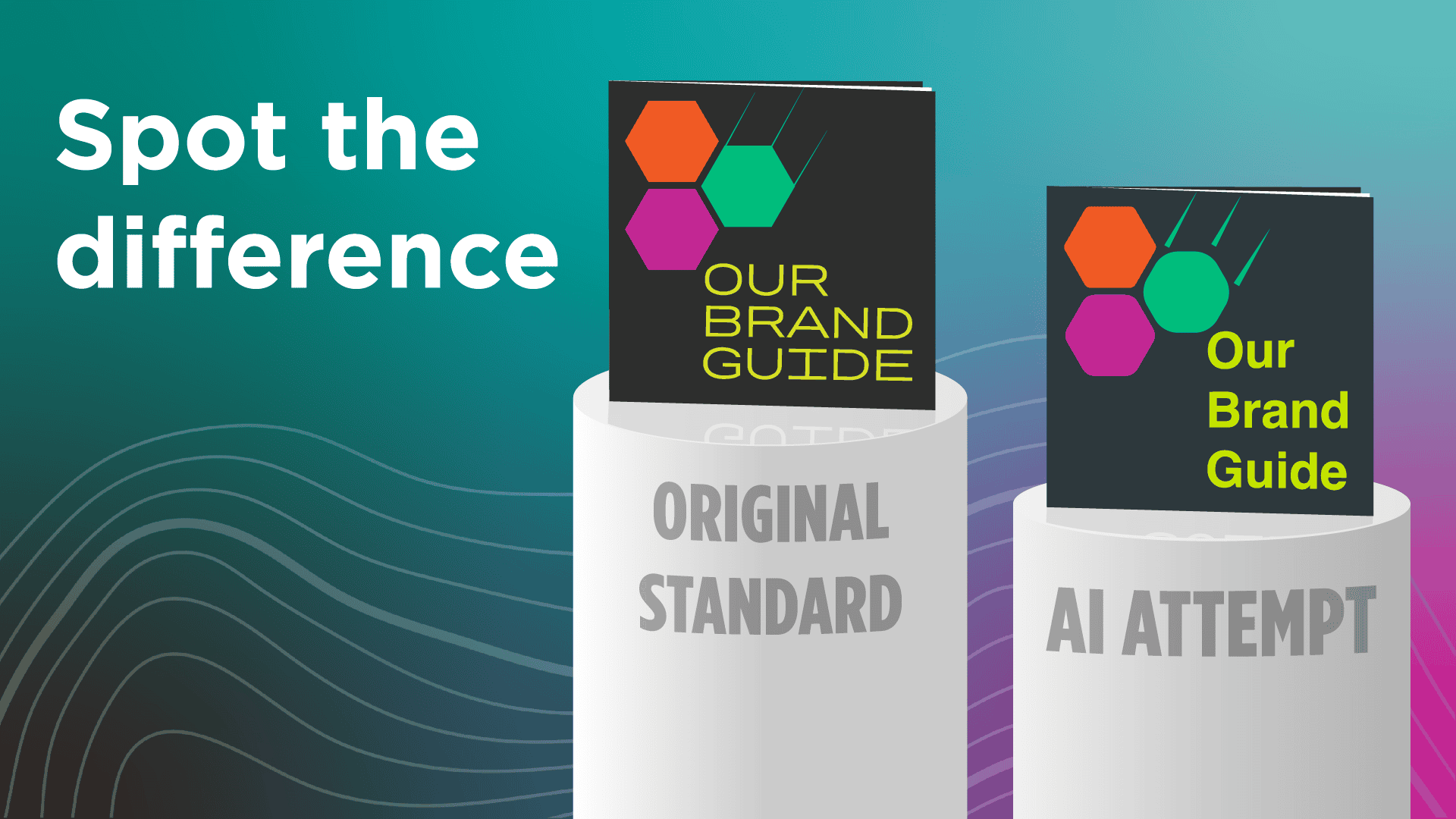
In a crowded environment, consistency is one of those signals.
It reflects how disciplined the organization is, how aligned its teams are, and how much attention it pays to detail.
Those details are more consequential than they may seem because they offer a glimpse behind the curtain. People notice—and they trust those signals more than anything a brand says about itself.
Valuing this is why iconic brands go to such lengths to ensure there’s no seam in the curtain for customers to see behind—and ideally, nothing behind the curtain period.
At its core, brand management encompasses everything—service, product, digital experiences, physical environments, and print. Every touchpoint connects to brand equity, either reinforcing or eroding it.
Solving this doesn’t require slowing down content creation, but it does require a structured approach to manage it.
The organizations that get this right don’t necessarily limit who can create. They build systems that are broad enough to manage it and fast enough to keep up. The latter is key.
Digital content has increased nearly 90-fold since 2010 (Statista/Semrush Report), but the systems used to govern brand have not scaled at the same rate. Marketing budgets have remained relatively flat as a percentage of revenue, even as the number of channels, formats, and contributors has expanded dramatically (Gartner CMO Spend Survey). At the same time, the marketing technology landscape has grown from roughly 150 tools in 2011 to more than 11,000 today (Chiefmartec Marketing Technology Landscape), increasing the number of systems and stakeholders involved in producing branded content.
The result is a widening gap between how fast brands can create content and how effectively they can manage it. Most organizations are now operating in an environment where content creation is effectively unconstrained, while brand oversight remains finite.
That imbalance is starting to show. Studies consistently find that a majority of organizations struggle with maintaining brand consistency across channels, despite recognizing its impact on revenue and trust (Marq Brand Consistency Report).
For marketing leaders, this creates a new operational reality: brand is no longer constrained by how much your organization can produce—but by how much it can control.

Print is often treated as a separate discipline, and in reality, it is one of the most unforgiving expressions of brand.
It forces decisions. It removes ambiguity. And once executed, it leaves little room for correction.
Managing print effectively requires two things:
This includes not just visual alignment, but production precision—color accuracy, material quality, and process control. Standards like G7 are critical here, ensuring that what is designed is what is produced, every time.
Brand portals and similar print asset management systems allow organizations to scale access without sacrificing control. Teams can order what they need, when they need it, but within a structured environment where templates, permissions, and approvals ensure that brand standards are maintained down to the substrates specified and the devices running the work.
The key is balance.
The goal is not to create bottlenecks that slow teams down. It’s to remove the ability to unintentionally go off-brand while preserving the speed modern organizations require.
In an environment where content creation is accelerating and decentralizing, brand management can’t efficiently rely on oversight alone. The right partners and a durable, systematic approach to brand governance can mitigate brand risk and meet the creation moment AI has ushered in. Because the brands that win won’t be the ones that create the most content.
They’ll be the ones that stay recognizable while doing it.