pronounced tie-see
Menu

Menu
Let’s face it—when it comes to lead-gen tactics, there’s a lot of hype, smoke, and razzle-dazzle out there for prospective advertisers to wade through. It’s our collective fault, as marketers. What can we say? We’re good at what we do. But sometimes, a little back-of-the-envelope math—paired with a look at real human behavior—is all it takes to see through the fog. Assuming you have an envelope handy, of course.
Every industry, audience, and business is unique, so we’ll use cited averages here—and you can calibrate or interpolate for your own situation.
There are a dozen advertising pricing models out there, but let’s focus on the big three: CPM, CPC, and CPA.
CPM (Cost Per Mille / Thousand Impressions):
You pay every time your ad is shown 1,000 times—whether it’s noticed or not. Often used for awareness, though “awareness” can be generous when your CTR is 0.05%.
CPC (Cost Per Click):
You pay only when someone (or something) clicks your ad. Great for driving traffic or leads—at least you know you bought some engagement.
CPA (Cost Per Acquisition / Action):
You pay when a defined conversion happens—a purchase, signup, or download. The most direct ROI-focused metric, but priced accordingly.
On the surface, digital looks like a steal. Display ads average around $10 CPM—$10 for 1,000 “impressions.” Search ads? About $38 CPM. Compare that to a postcard mailing at roughly $420 CPM. That’s print and postage. But whoa—42× more expensive sounds like a nonstarter.

As mentioned, CPM is generally used for broad brand-awareness campaigns. But impressions only matter if they actually create awareness—if they’re seen and processed. If you read The Offline Advantage in an AI-Saturated World, you’ll recall the behavioral science behind this: only about 1% of your visual field is high-resolution, and even objects placed directly in that view can go unprocessed. In a crowded digital feed, the odds of your ad truly registering with the brain are slim. Let’s put numbers on it using the $10 (digital) and $420 (print) examples.
Display ads see average click-through rates between 0.05% and 0.1% (CXL study)—roughly one click per thousand impressions, on the high side. Clicks aren’t impressions, but it’s a useful proxy for real impressions.
Postcards? Even using the conservative end of industry benchmarks, 30% get read—and many sources cite 50–80% (DataAxel). Using the low end, that’s 300 “real” impressions per 1,000 pieces.
Postcards cost 42× more but get 300× better engagement.
In dollars per engagement, that’s $10 per real impression for digital and $1.40 for postcards.
Okay—let’s say that’s unfair to digital. Let’s say real digital impressions are 10× higher than that. The postcard becomes about $0.40 more expensive per true impression—based on the low end for mail and the high end for display ads.
To be fair, let’s see what using a mid-range read rate for the postcard (65%) does to the math: the direct mail impression cost drops to $0.65, somewhere between $0.35 and $8.35 less than digital CPM.
There’s another important caveat that makes print’s value proposition stronger: awareness is only valuable if it leads to immediate action or sticks in memory. Physical mail isn’t just noticed more—it’s remembered longer and trusted more.

The Millward Brown study showed that paper-based marketing stimulates more emotional processing and memory recall than digital. A Hechinger Report analysis confirmed similar results in learning contexts.
But the advantage goes beyond direct mail. Printed collateral—brochures, leave-behinds, product sheets, branded folders—has linger time that digital rarely matches. A postcard on the kitchen counter, a brochure on a desk, a folder on a conference table—these pieces can and do generate multiple exposures over days or weeks.
Digital CPM ads burn budget with every impression, while print often keeps earning impressions long after delivery.
And unlike digital ads fighting banner blindness and phishing fatigue, print gets an extra tailwind: Informed Delivery®. Roughly 30% of U.S. households preview their mail digitally before it arrives (USPS), adding one more impression at no additional cost.
Sure, CPC ads solve some CPM problems—you only pay for clicks. But clicks rarely equal conversions. We want subscriptions, downloads, donations, purchases, or meeting requests.
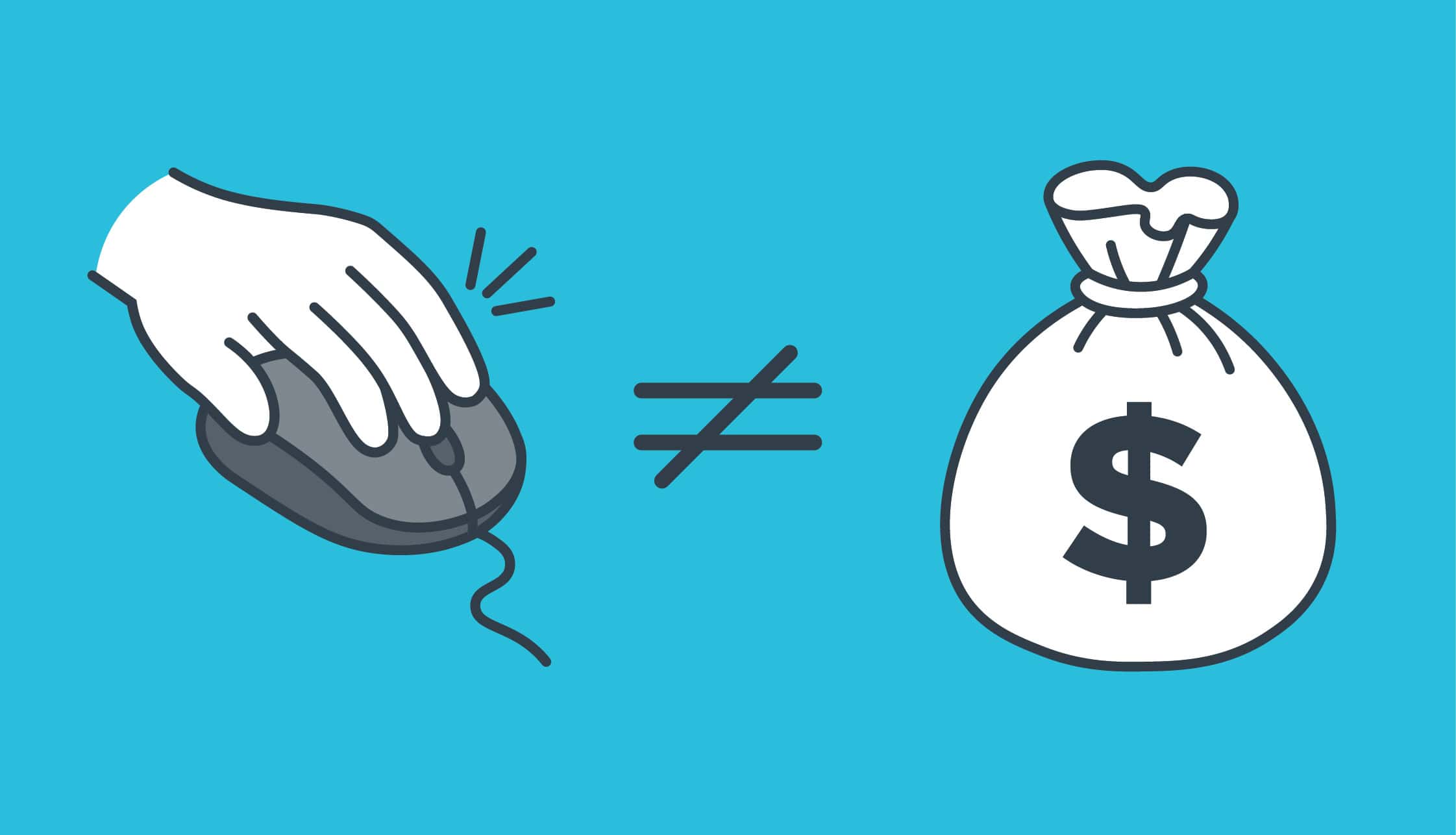
According to an Agency Analytics report, the median 2025 CPC is $1.80. Most sources suggest it takes about 50 to 100 clicks to generate one conversion—so let’s calculate both:
Digital CPC to CPA Conversion:
$1.80 × 50 clicks per conversion = $90 per conversion
$1.80 × 100 clicks per conversion = $180 per conversion
According to aUSPS survey, 71% of businesses said their direct mail response rate was between 11% and 15%. A range of sources indicate the “sale conversion” rate for direct mail is between 0.25% and 6%.
Let’s run all four scenarios for this:
Print “CPC” to CPA Conversion:
@15% → $420 CPM → 150 responses = $2.80 per response (+$1 higher than digital)
@11% → $420 CPM → 110 responses = $3.82 per response (+$2.02 higher than digital)
@0.25% Sale Conversion → 2.5 conversions = $168 per sale conversion (+$78)
@6% Sale Conversion → 60 conversions = $7 per sale conversion (−$83)
Many mail providers advertise the average “real conversion” rate for mail as 3.5%. This sits right in the middle of the range, so let’s math that out too:
There’s quite a range here, and that makes sense. Just because we serve ads doesn’t mean they’ll perform. All the basics still apply—targeting, messaging, creative, timing—and, of course, your closing process. Maybe you’re able to close or sell immediately, or maybe it takes people to seal the final deal later.
At a sales conversion rate of just 0.47%, print hits cost-parity with digital using the averages above. That’s near the bottom of the normal direct mail performance range (0.25%–6%), so most real-world mailings outperform that threshold—often by several multiples. In other words, print doesn’t need to knock it out of the park to compete; and there’s significantly more ROI potential for well-executed direct mail campaigns.

When digital and direct-mail conversion costs are the same, direct mail still offers more impression value—print impressions are trusted more, remembered better, and often shared.
The awareness value of print is sometimes hard to isolate, and the appeal of lower-cost digital alternatives—like email—is ever-alluring. There are certainly arguments to be made for email in a wide range of use cases, but the now famous J.C. Penny and Nordstrom attempts at replacing mail with email offer insights into how the media perform differently. Both became case studies in change management and marketing that are still taught today. Sales declines were clearly linked to attempts to replace mail programs with digital alternatives—and the mailings for both brands were eventually re-implemented.
We’ve already converted CPC and CPM into what is effectively CPA outside of that specific pricing model. According to Google, the average cost-per-acquisition across all industries using CPA is $45. However, a 2025 PPC report paints a more accurate picture by breaking down search and display categories—and industry differences. Some average as low as $23, most hover around $80, and several exceed $100.
It’s difficult to generalize in useful ways here—and believe me, we’re trying our best to keep this useful, accurate, and actionable. The challenge lies in the many definitions of acquisition, each carrying a different level of difficulty and value. And, again, “acquisition” doesn’t necessarily mean “sale conversion”—in fact, that’s usually the exception.
This 2025 FPS report breaks down Customer Acquisition Cost (CAC) by industry. It’s a worthwhile deep dive, but here are the key takeaways:
The high end of CAC hits professional and B2B services at an average $914.
Consumer products and local services sit at the low end, averaging $311.
The lowest single category, eCommerce, averages $86.
We’re focusing on ad-cost comparisons—just one slice of CAC—but it’s helpful context. Where CPA differs dramatically from CAC, you can assume there’s a lot more work and cost required to win a true “sale conversion.”
Given how slippery the “A” in CPA can be, let’s break it into two categories—one where “acquisition” means transaction completed, and another where it means lead generated.
This one’s simple:
The only difference here is we need a lead-to-sale conversion rate. Let’s assume 1 in 5, or 20%.
We already established that $45 is low, but let’s use it anyway:
Average Digital CPA: $45 per lead → 1 in 5 closes = $225 per sale conversion
Average Print CPA: $12 per lead → 1 in 5 closes = $60 per sale conversion
The truth is, either print or digital could outperform the other depending on variables like audience, offer, timing, and optimization. Meaningful analysis can’t capture every nuance across industries or channels. Still, one takeaway stands out: they’re comparable—both can drive conversions, and either can be more cost-effective.
Another key point: for digital CPAs to remain low, your customer lifetime value (CLV) and/or competition must also be low. Digital ads are auctions; where there’s margin, there’s competition—and higher prices. It’s perhaps the most elegant way to raise prices on advertisers ever devised.
Direct mail works differently. Mail costs are among the few marketing tactics not directly tied to competition. Trade shows, events, and digital ads all become more expensive as their value increases—but mail remains stable. This is an opportunity for brands with high LTV and heavy digital competition.
For example, if digital competition pushes your CPA to $130 while your direct-mail CPA is 4× higher than average at $48, print yields a massive ROI advantage. There isn’t a universal rule here, but it highlights mail’s potential: it can be far more cost-effective than digital.
LOB reports this annually in its surveys of mail-program users:
Digital ads and owned digital media are indispensable in the middle and bottom of the funnel. But for top-of-funnel awareness? The math doesn’t lie: Offline communications deliver greater attention, trust, and recall value than digital alternatives—on average.
Comparing the three dominant ad-pricing models makes one thing clear: direct mail can hold its own—and often outperform—digital CPC and CPA campaigns.
AI-fueled digital competition is saturating online channels, eroding efficiency, while direct mail and print exist in a steadier ecosystem—one where traditional value appears to be rising fast.
When teams refine targeting, test and optimize messaging, improve timing, and leverage data-driven personalization, CPM stays constant while CPA falls—which explains why 79% of businesses using direct mail in 2025 report it as their highest-ROI channel.
Ultimately, it all comes down to ROI. Digital channels are vital to conversion. It isn’t possible to maximize ROI without investing in all the touch points your customers hit along their way to conversion. But, print—whether mailed, hand delivered or used in experiential marketing is worth experimenting with. The costs are undeniably higher than digital alternatives at face value, but the math we’ve done makes it clear: print communications offer unique ROI opportunities that can surpass digital alternatives. Most companies with established mail programs identify it as their highest ROI channel. And, as AI fuels new levels of digital competition and sophistication, being present outside of that ecosystem is likely to become increasingly valuable.
In case you missed it:

If you made it here, thank you. This article was really written by the author—should I break into first person tense here? (I did use AI for grammatical help.) If you’re wondering why talk about offline communication in a digital publication—you got me! Except, this will also take letter form and go out via personalized USPS marketing mail. So, we’re eating our own cooking here.
If you would like to talk to an offline communications expert, please reach out. Team Thysse has deep subject matter expertise and industry experience to offer—and we’re happy to share that with you.
If instead of a subject matter expert you’d like to reach me directly, there’s about a 5% chance I’ll read an email but I’ll 100% open a letter you mail me.